The USA in Autumn: New York, New England, and Washington in One Trip
 Simply Team
6 min read
Simply Team
6 min read
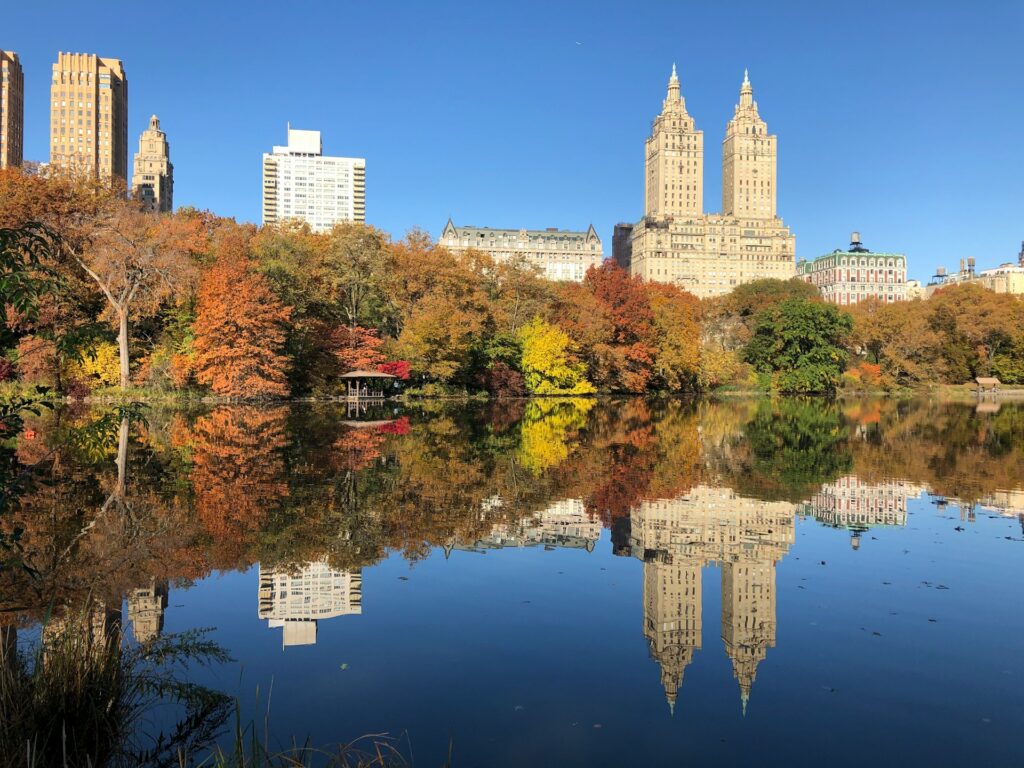
When the air cools along the US East Coast, one of the most beautiful travel seasons in the world begins. From late September to early November the forests turn red, orange, and gold, and walking the cities becomes a pleasure again after the summer heat. This guide maps out a route through New York, rural New England, Boston, and the capital, Washington, along with everything you need to stay connected from the moment you land.
When to go: the color moves north to south
The secret of an American autumn is that the color does not arrive everywhere at once. It peaks first in northern New England, in Vermont and New Hampshire, between late September and mid-October, then moves south to Boston, Massachusetts, and Connecticut in the second half of October, and finally reaches New York at the end of October and into early November. Central Park usually runs later than the rest of the city, because the shade of the surrounding towers delays the change.
The practical rule: if your trip falls in the second half of October or early November, focus on the south, meaning New York, the Hudson Valley, and Boston, rather than the northern mountains, which will be past their peak. Weather can shift the timing by a few days either way, so check the foliage map that Central Park publishes and the state foliage reports before you fix your dates. Pack a light coat too, since evenings are cold even after a sunny day.
New York: Central Park and the Hudson Valley
Give New York at least four days. Start with Central Park early in the morning: the wooded paths of the Ramble, Bow Bridge over the Lake, and the running track around the Reservoir, where the colored trees reflect on the water. In the afternoon, walk the High Line, the elevated park above the streets of the West Side.
For the best day of the trip, take the train from Grand Central north on the Hudson Line to Cold Spring or Beacon. The tracks run right along the river and the colored hills, and you are back in the evening without needing a car. On the New York subway there is no special card to buy: tap your contactless card or phone wallet at the gate and walk straight in.
Boston and rural New England
Boston is a few hours from New York by train along the coastal line. It is one of the oldest cities in America, and autumn shows it at its best: Boston Common and the Public Garden next to it with their colored trees, and the Freedom Trail, marked by a red line on the sidewalks, linking the historic sights of the city in a single walk.
For a true leaf trip, rent a car for a day or two. In mid-October head west to the Berkshire hills of Massachusetts, and later in the month go south to the quiet villages of Connecticut. If your trip is in early October, drive north to the White Mountains of New Hampshire, where the Kancamagus Highway is one of the most famous autumn drives in America. One important note: on mountain roads and in dense forest, coverage can drop on some stretches, as it does for every network there, so download your route offline before you set out.
Washington: museums with no paid tickets
Finish in the capital, a few hours by train from New York. Along the National Mall stand the Smithsonian museums: Natural History, Air and Space, American History, and more, and entry is free. Some ask for a free timed-entry pass, so book it from your phone before the day. In the evening, walk from the Washington Monument to the Lincoln Memorial, then on to Georgetown and its old streets on the riverbank.
A suggested 12-day route
- New York: four nights, including a full day in the Hudson Valley.
- Boston and New England: four nights, including two days by car in the countryside.
- Washington: three nights for the museums, the National Mall, and Georgetown.
You can also start in Washington and finish in New York if that suits your flights better, since one rail line links all three cities.
Connected from the first minute to the last leaf
- Before you fly: install the eSIM from the Simply app at home on stable Wi-Fi, and make sure your phone is on the compatible devices list.
- On landing: switch on the travel line and enable data roaming on it alone, keeping roaming off on your main SIM. Full steps are in the eSIM installation guide.
- One plan for all three cities: the USA plan covers you in New York, Boston, and Washington and on the main highways between them, with speeds up to 5G where available.
- The time difference: the East Coast is seven hours behind Riyadh in October, and eight hours once US clocks go back on 1 November. Keep that in mind when you plan calls home and work meetings.
- Your Saudi number: stays in place and keeps receiving calls and bank verification texts as usual. Details are in the keep your number while traveling guide.
- If the connection does not appear: do not delete the eSIM. Work through the eSIM troubleshooting guide step by step.
- How much data: for maps, ride apps, and messaging, 1 to 2 GB a day is usually enough, more if you share a lot of video of the autumn colors.
Adding Niagara Falls and Canada?
Niagara Falls, at the far western edge of New York State, is a favorite add-on, and the Canadian side of the falls is just one bridge away. If your trip will combine the USA and Canada, look at the Global bundle: 108 destinations on one eSIM, with the full country list shown in the app before you buy. For a USA-only trip, the single-country plan is the better deal. Check the entry requirements for Canada separately before you cross, and connectivity details for that side are on the Canada page.
Everything about connectivity in the United States is on the USA page, while plans and durations live in the Simply app. And if leaf season is your thing, our Japan in autumn guide is another trip worth planning. Have a great autumn between Central Park and the New England countryside.

Written by
Simply Team